Wooden Shoe Tulip Festival: Dog Friendly Oregon Coast & Countryside

How dog friendly is Oregon? VERY PET FRIENDLY

The Pacific Northwest is a dog friendly paradise. Oregon has so many dog friendly activities wherever you look. It is time that we finally write about the wonderful spots we have visited up north.  In our most recent visit, we packed up the car and drove 12 hours with both boys. As always, the boys handled traveling with grace – this was Samson’s first major trip and he spent the entire time napping (being cute is hard work). There were so many pet friendly activities in the Portland Area and along the Oregon coast. The Oregon coast is especially pet friendly.

We arrived in Silverton, OR around 3am and crawled into bed for our 6am sunrise wakeup – yes, we travel like lunatics. Life is too short!  We spent each morning visiting the Wooden Shoe Farm Tulips for sunrise before heading off to our next stops.  We met up with our Instagram friends in Portland, went on a few hikes, and then made our way back down the Oregon Coast towards home. Overall, we drove over 1600 miles and hit up the coast in 4 days. We’re excited to check out other parts of the coast next year. This post focuses on the areas we visited outside of the city.  For our trip to Portland, see our Portland Blog here.

dog in front of colorful tulips

dog in front of tulips at sunrise

many retrievers dogs in front of flowers

puppy with flower tulips
labrador in front of pink tulip flowers
puppy in front of red tulips

Map of Dog Friendly Activities in Oregon:

Pet Friendly Hotel Getaway: Where to Stay in Oregon With your Dog

When to visit Oregon
The earliest we have visited Oregon is at the end of April – Oregon is known for being perpetually covered by a light drizzle for most months of the year. We visited in April for the Wooden Shoe Tulip Festival, but previously visited during the sunny summer months.

Where to stay in Oregon
On our most recent visit, we were interested in exploring outside of Portland so we stayed 45 minutes outside of the city at the Silverton Inn
On our way back down the coast, we stayed at the Brookings, OR Beachfront Inn. We got a pet friendly beachfront room for less than $100 per night!

Pet Friendly Things to do: Taking your dog to the Oregon Countryside

Pet Friendly Wooden Shoe Tulip Farm
Woodburn, OR
The number one reason we drove up to Oregon in April was to attend the Wooden Shoe Tulip Festival.  The festival runs from end of March through end of April but the exact dates vary by year.  For the best blooms, it’s best to visit during the later half of the festival season.  The festival is dog friendly and takes place on over 40 acres of blooming flowers. On weekend mornings, rainbow hot air balloons are released to bring additional colors to the scene.

Important Tip: Get the season pass for the opportunity to visit the tulips outside of usual business hours. The season pass is valid for an entire car to enter before and after festival hours. Without the season pass,  there is limited parking and the crowds are brutal by 9am.  By the time we left the tulips, the fields were swarmed by crowds and there was a long line of cars waiting to get into the parking lot – the chaos put a damper on the serene blooms. We got in around 6:30am and were out by 9 with each visit.
puppy with flowers

Pet Friendly Swan Island Dahlias
Canby, OR

If you missed out on the Tulip Festival, don’t fret – the Swan Island Dahlias are similarly beautiful and pet friendly. The fields are open to the public from August through September. The Dahlia farm includes over 360 varieties of colorful flowers on 40 acres of land.  We visited in late summer and were pleasantly surprised at how quiet and peaceful the fields were.

dog with two horses

Pet Friendly Downtown Silverton
Silverton, OR
We stayed in Silverton, OR to be close to the festival for sunrise and got to enjoy the picturesque downtown for breakfast after visiting the tulip fields. Our top pet friendly eateries in Silvertown are the Main Street Bistro & Gather.  They are located across the street from each other so check out the menus and pick a table outside.

Taking Your Dog to the Oregon Coast

Pet Friendly Cannon Beach
Cannon Beach, OR
We didn’t make it to Cannon Beach but it is on our list of dog friendly beaches for next time and should def be on any Oregon Coast bucket list. This beach is easily identified by “Hay Stack Rock” overlooking the sand. After fun at the beach, head over to the town for a taste of art and culture.
dog at the beach
Pet Friendly Newport’s Historic Bayfront
Newport, OR
The town of Newport mirrors the coastal towns of New England. We walked down the main strip and got some food.  During most of the year, the echoing sound of Sea Lions resonates through the town.  We ate on the outdoor patio of Clearwater Restaurant patio for a front row seat to the noisy Seals. The food was great and the seal’s quirky antics were mesmerizing. For outdoor fun, Yaquina Head Outstanding Natural Area is a pet friendly excursion nearby

Pet Friendly Seal Rock State Park
Seal Rock, OR
If you are pressed for time, you can skip this stop. We stopped at Seal Rock to stretch our legs and let the dogs run on the beach. Think: big rocks, sand, and beach.

Pet Friendly Cape Perpetua Lookout
Yachats, OR
We took a pit stop to take in the views at Cape Perpetua lookout – the dogs stayed in the car but there were plenty of well behaved pups  This stop can take as short or long as you’d like depending on if you want to walk the trails – we just took in the view, and were on our way. 

Pet Friendly Beachfront Brookings
Brookings, OR
The Beachfront Inn is a hidden gem in Brookings, OR.  We stayed in an oceanfront room for less than $100 per night and breakfast was included. The Inn is located on Sporthaven Beach – a rocky beach on the Pacific Ocean. The pebbles resembled the types of beaches you find in the south of France and Spain. We had the beach to ourselves in the early morning.

dog at seal rock oregon

view of the oregon coast

Take Your Dog to the Oregon Dunes

Pet Friendly Oregon Dunes National Recreation Area
Reedsport, OR

We finally crossed the Oregon Dunes off our bucket list! The dunes can be accessed at many different entry points but not all are pet friendly and some are used extensively for ATVs. We researched the best place to see the dunes with dogs and found the Tahkenitch Dunes Trail If desired, you can follow the trail for an entire loop that includes forest, dunes, and beach all in one visit. The trailhead has two entry points and both eventually get to the dunes.  We chose the trailhead on the right side of the parking lot to start our loop (NOT the one with the picnic tables). This trailhead was only about a mile to the dunes. On our visit, there was only one other car in the parking lot and we didn’t see anyone on the trail. The dogs played in the sand for about an hour and then we headed back down the coast.

PNWonderland Awaits!
-Your Pal Cal

International Dog Travel Rules & Regulations

How to travel to Europe with your Dog: International Pet Transport

Are you looking to bring your dog to Europe? There is a lot of paperwork and regulations for international dog travel but it’s worth it. We travel from San Francisco to Paris frequently so we’ve put together some resources to get you started on international dog travel. This post is just a starting point – laws vary by country and so it is pertinent to research the country you plan to enter with your dog.  The USDA APHIS website will be your source of truth so make sure to meet all those requirements for customs and border control.

Can You Travel Internationally with a Dog? What are the International & Customs Laws for Dogs?

  • Service Dog and ESA laws are NOT covered in the same way as they are in the USA so you will need to research the laws before travel – you will not be covered by the same laws and working dogs are not as common in countries outside of the United States. Even if the laws do cover working dogs in international countries, you unfortunately can’t expect that access will always be granted.
  • Some countries only recognize “ADI Accredited” Service Dogs for entry into the country via in-cabin plane travel. This means that “Owner Trained” Service Dogs are not able to enter via plane (UK is one example but there are more). Sometimes there are ways around this by flying into a different EU country and then driving into the UK by car through the tunnel.
  • Hawaii/Caribbean Islands: Although these are not Europe, they have unique requirements for entering with service dogs to avoid quarantine.
  • Dog food is often restricted at customs. Have a pet store ready at your destination or pre-order. Your favorite brands may not be available overseas so look for a food with similar grain profile and protein levels.

Bringing a Service Dog to Europe? Can all dogs travel in Cabin?

Every airline has different regulations regarding whether they allow SDs and ESAs in cabin. Low budget carrier tend to be the most restrictive especially within Europe. Delta, United, Air France, and Lufthansa are great airlines to check out if traveling with your dog. Most budget airlines appear to allow service dogs but we have only ever used Air France/Delta based on flight availability from California. Samson is a working Service Dog so he always is able to fly in cabin. Being a service dog does not exempt the dogs from all the required import paperwork.
  • Some airlines have rules that limit the aircraft to 1 total animal (regardless of status) on board – First to check in gets to board with their animal and the next person is out of luck.
  • Some airlines do not recognize assistance dogs at all
  • Some airlines require ALL dogs over 10kg to fly in the cargo hold
  • Generally, pets under 10kg can travel with their handler with appropriate documentation.
  • Smaller airlines for stop over travel (I.e small airlines that fly between EU countries) are least likely to be accommodating and allow the pet on board
  • Some countries and airlines ONLY recognize internationally accredited program trained service dogs (ADI) and guide dogs to fly in cabin.

Bringing a Dog to France from the United States: Traveling to Paris with our Dog

We have traveled to France a few times on flights booked by Delta (operated by Air France). The flights were each around 12 hours long and we didn’t have any issues while on board. For Air France flights, We recommend purchasing tickets that allow you to choose seats before check in as you’ll find Air France customer service to not be as accommodating with seat selections as US airlines. Each time we travel to Paris, we are told over the phone that there are seats reserved for passengers with disabilities but once we get to the airport we are told the opposite. We will be sure to pay a premium to choose our seats next time.

We brought our international paperwork, training documentation (we always keep CGC, CGCU, and CGCA titles with us when we travel), and doctor’s notes which were all checked in San Francisco at check in. Even if you are traveling with a Service Dog, doctor documentation is important to have once you leave the United States.

Once we get off the long flight, there’s no pet relief station so I set up a potty pad for in the human bathroom and the dog decides if they want to use it. I use the command “go potty” and I find that the dog will only relieve themselves if it’s an emergency.

At Paris customs, border police checks the paperwork but hasn’t ever asked any questions. They are most interested in the EU France Health Certificate – they check for the required signatures and stamps and then we are on our way. We always have the same experience on the way back into the United States.

Overall we’ve had no issues – Our biggest tip is to be over prepared for international travel to minimize stress.

What do I Need to Take my Dog to Europe? Pet Travel Regulations for France (country requirements vary)

  • 16 character microchip Implanted BEFORE original rabies vaccine.
    • The microchip is read at customs so make sure you know where it is located – you can generally feel the rice shaped chip around the shoulder blades.The microchip reader can only read microchips in the 16 character format
  • Rabies Vaccine for International Travel
    • 1 or 3 year rabies vaccine? France recognizes the 3 year rabies vaccine, some countries only recognize the 1 year vaccine.
    • If this is your dog’s FIRST rabies vaccine ever or if a previous vaccine has expired, you cannot travel into France until 21 days after the shot. Calvin was up to date with his rabies shot so this did not apply to us.
  • Country Specific Health Certificate (complete at your vet’s office)
    • Completed by a USDA Accredited Veterinarian no more than 10 DAYS before travel (thats a mouthful)
    • Most countries in the EU have country specific health certificates. If the country does not have a specific health certificate, there is a general one that can be completed. We got both completed just in case.
    • IMPORTANT:
      • The health certificate MUST be completed by a Veterinarian that is accredited by the USDA (This is not common so make sure your vet has this title)
      • The health certificate must be completed less than 10 days before entry at the destination. We completed ours the day before travel.
  • Endorse the health certificate (complete at a USDA office)
    • The official EU/French health certificate is not valid until it has been stamped and embossed by the USDA Office
    • See here for locations near you
    • Make an appointment in advance as this has to be done within 10 days of your travel date and not all offices accept walk ins (think DMV style experience)
    • Double check that every page of your health certificate is properly filled out and signed in appropriate places
  • Recommended: Carry a rabies certificate, full vaccine history, spay/neuter certificate, extra copy of health certificate, doctor’s note (even if your dog is an SD), proof of training (CGC, PAT, board and train, ect), written confirmation from the airline that your animal is allowed to travel in cabin, printed airline policies.
  • Submit any required paperwork to the airline at least 48 hours before travel.
  • Bon Voyage! 

Additional Requirements for International Pet Travel

Check the pet import requirements for the country you will be traveling to here. Some countries require quarantine, additional testing, deworming, ect.
  • The UK & Iceland have additional rules and make it difficult to enter with an animal
  • We found that most EU countries have less stringent requirements for pet travel compared to the UK. 

How to Prepare Your Dog for the Airplane

Master domestic flights with your dog
  • Calvin had been on about 75 domestic flights before we attempted a >10 hour flight (in total we were traveling for almost 18 hours). Samson had been on multiple flights as well and had no issues. If your dog is able to settle down and relax, they won’t mind the longer international flight.
Limit food & water when traveling with your dog
  • For a flight over 10 hours, limit food at least 12 hours before travel. Limit water for 6 hours before travel and then allow your dog to have ice cubes/sips of water throughout the flight.
Stay organized
  • Get a binder for all your paperwork. Make sure all your appointments (Vet + USDA appointments) are booked in advance
  • Call airlines before hand and get confirmation that they know you are traveling with an animal
Overnight flight if possible
  • If the flight is overnight, your dog will be used to sleeping and will hopefully settle quickly and sleep through the night. Additionally, the airplane will be dark so they’ll have a better idea that it is time to sleep.
Our packing essentials when traveling with our dog
  • Portable bowl
  • Food & Treats for the flight (will have to be thrown out before customs)
  • Familiar mat to sleep on
  • Blanket

What paperwork do I need to travel with my dog? Resources & Paperwork for Bringing Your Dog Internationally

Dog Travel Checklist

[]Spay & Neuter certificate
[]History of all vaccines
[]History of rabies vaccine
[]Rabies tag & SF dog tag
[]EU Health Certificate for USDA Vet
[]Completed Health Certificate for APHIS pet import office
[]Doctor’s note (including trained tasks if applicable)
[]Training documentation
[]Call airline and get confirmation that pet is flying in cabin
[]Call airline to confirm seats
[]Submit airline specific paperwork
[]Organize all paperwork in binder
[]Research whether treats will be allowed into the country. Find pet store at destination if not.
[]Microchip number & proof of microchip

Dog Friendly Activities for your Pet in Portland, Oregon

butterfly on dogs nose in portland rose test garden

Dog Friendly Places in Portland: Is Portland Really That Pet Friendly? (YES)

From Portland Dog Friendly Bars to Off Leash Dog Hikes – The Pacific Northwest is a must visit with your dog. There are so many dog friendly activities throughout Portland that we have visited multiple times.
Portland is a tried and true favorite – we keep coming back for more. Every time we visit, we are welcomed with great vibes from the locals and days full of activity.  We’ve been to Portland 3 times with Calvin and still haven’t even scratched the surface of what the city has to offer. We know we will be back but for now, we would like to share the highlights from our recent trips.

Pet friendly hotels Portland – Where to stay and when to visit Portland with your Dog

When to visit Portland with your Dog
Wet until the summer sun comes around

Our favorite time to visit Portland is after the rainy season – during our summer visits we have been graced with sunshine and good weather.

Where to stay in Portland with your Dog
Boutique Hotel or Budget Friendly AirBnb

Oregon is one of the more pet friendly places that we have visited and you’ll never have trouble finding lodging with fido in the city.
When we travel, we always check for a nearby Kimpton Hotel.  Kimpton Hotels are pet friendly at no extra charge. The rooms are always quirky and unique, and your pet will always be welcomed in a friendly manner. We have previously stayed at the Kimpton Monaco in downtown Portland but have also tried a pet friendly AirBnb when we were on more of a budget. AirBnb on a budget means no frills, but when we are out exploring all day, we are less inclined to spend a premium for a bed and a pillow. Fun fact:  On our first visit to Portland, we actually stayed at an AirBnb that didn’t even have a restroom (at least it was cheap).
dog under covers
dog in bed

Portland Map of Dog Friendly Activities:

Explore Portland with your Dog: Pet Friendly Things to Do

The Pearl District & Downtown Portland
Mingle with the locals and enjoy the river

A bite to eat in the Pearl: The Pearl District and Downtown Portland are walkable parts of the city that can easily be explored together. Gone are the Pearl’s days of warehouses and manufacturing – the neighborhood has now evolved as the host of modern, upscale eateries, luxury condos, and art galleries. For those who have visited New York City, this area reminded us of the trendy Chelsea neighborhood of NYC. The Pearl District has a great ambience and lots of options to grab a bite to eat. You’ll find ample outdoor seating for dining with fido and establishments are always welcoming. Check out the top ten places to eat in the Pearl here.
a labradoodle, golden retriever, boxer and labrador in the grass

golden retriever puppy and maltese sitting at a table

Tom McCall Waterfront Park: We visit the Waterfront Park each time we find ourselves in Oregon.  The riverfront park is always bustling with activity – Strolling along the park is a great way to enjoy the Willamette River as you walk towards downtown. We got the feeling that this area is a popular place for locals to meet up and relax.  On the weekends, the park becomes even more exciting with all the booths from the local farmer’s market.  One thing to note is that although this part of the city is safe and bustling with activity, it is also home to those who unfortunately struggle with drugs & addiction. We did not feel unsafe but did notice the high presence of individuals struggling on the street or doing drugs.
 
Downtown & Ira Keller Fountain Park: We came across this park while walking around downtown Portland. The park was nondescript at first but we soon realized that is is actually a work of architectural splendor.  This manmade “fountain” is more like a set of cascading waterfalls in the midst of concrete. Sit down for a moment and enjoy the sound of the falling water.  Stretch your legs, have a picnic, or just snap a few photos and be on your way.
 

Northwest District “Nob Hill”
Old fashioned fancy vibes in Portland

The Northwest District is lined with colorful Victorian homes and store fronts most frequently compared to the ones in San Francisco. This part of town has an old fashioned but fancy vibe to it – you’ll find lots of overpriced shops and boutiques.  Compared to some of the other neighborhoods in Portland, Northwest District has more of the Martha’s Vineyard, Cape Cod upscale feeling. We have heard from locals that this neighborhood isn’t really their “vibe” but regardless, we found the main street is great for grazing on snacks and window shopping. The area is clean, well manicured and home to many pet friendly restaurants.

Washington Park
Stop and smell the roses then enjoy the trees

International Rose Test Garden: The Rose Test Garden is a #1 must visit in Portland during the summer months….and it’s entirely FREE. The pet friendly international rose test garden is home to over 8,000 types of roses and is currently the oldest public rose test garden in the United States. Unfortunately, if you visit before June you’ll be disappointed that the flowers are still dormant. During bloom, you can wander through the rows of flowers enjoying all the different colors and smells. To avoid crowds, stop and smell the roses first thing in the early morning or during sunset.
 dog with roses

 
Pittock Mansion: We’d consider this stop optional…we visited because we were in the area to see the Rose Test Garden – the Pittock Mansion is beautiful but not worth the visit on a cloudy day. Pets are not allowed inside the mansion so you’ll want to check the weather to make sure you can enjoy the grounds and views.  The mansion is at the top of a hill and the gardens surrounding it are well manicured and pleasant for a stroll. If you visit on a sunny day you can see all of Portland from the lookout point.
Hoyt Arboretum: From the Hoyt Arboretum you can enjoy an endless combination of trails and a breath of fresh air in the city – grab a map and explore.

Alberta Art District
Hipsters & art

We’d best describe this part of Portland as the art district and home to our favorite Portland brunch spot.  We brunch at the Tin Shed Garden Cafe (top 25 places to eat in Portland) each time we are in the area. Don’t feed your pup breakfast that morning because the Tin Shed has a special menu just for dogs! Check the website before you visit to see if there are any special dog days where your pup can eat for free! These days change based on the season. After filling up, we like to walk down Alberta Street and stop into all the quirky shops along the way. On a warm day, grab an ice cream at the famous Salt & Straw. The more popular dining options have a long wait, so put your name down and then explore the art district in the meantime.
 

East Portland
Stroll on the floating walkway

Eastbank Esplanade: If you are staying on the East side of the Willamette, you can enjoy the river from the floating walkway known as the Eastbank Esplanade.  This is a great way to take in the views and get a walk in. You can follow the Esplanade along the river for 1.5 miles.

South East Portland
Quiet hideaway on the outskirts of Portland

Crystal Springs Rhododendron Garden: This park is a hidden gem on the outskirts of Portland.  We visited for sunset right before closing and were shocked at how few people we saw as we strolled through the gardens. The staff recommended coming back in May as the Rhododendrons go into bloom (we visited in July). Calvin enjoyed watching the ducks from afar and joining us for a peaceful stroll. Afterwards, you can find some great food in the nearby Sellwood district.

Off Leash Dog Hiking & Swimming in Portland

Pet Friendly Portland: Run wild & free
Portland has a lot of open spaces for the dogs to run and play – we have narrowed it down to our top 3 favorite places to bring the dogs when we visit Portland.
 
Sandy River Delta Park (East)
The Sandy River Delta Park is a favorite among the locals and pet friendly.  The park provides endless trails for dogs to run off leash including a flowing river for them to swim in. The park used to be a cattle ranch but has now gone to the dogs – choose between several trails and open fields.
 
Tryon Creek State National Area (South-West)
Tryon Creek offers the more classic PNW trail experience – forests and greenery.  We visited during a rain storm but were very well covered by the trees.
 
Sellwood Riverfront Park (South-East)
Sellwood Riverfront Park provides all the freedom of a dog beach without the long drive to the coast.  There is an elevated path along the water with a large open field, but we went right for the beach. Definitely a must visit for dog lovers looking for a peaceful stroll along the water.
 
Forest Park
The park is made up of multiple trails and we only ran into a few people on our walk. Regarding leash rules for the trails – the rule of thumb for Forest Park is that dogs must be under full voice control and remain close to their handlers for off leash fun. It’s definitely not the kind of “free for all” dog park that you will find at Sellwood or Sandy River. With Calvin at a heel, we still got to have lots of fun.

Pet Friendly Activities: The Water Falls

The Waterfalls in Portland are Dog Friendly: Lots of pretty water, lots of loud crowds
The (consistent) rainy season in Portland makes for beautiful natural waterfalls.  If you are not a fan of crowds, I would keep away the falls below and search for a more quiet water fall experience.  Both of our visits were chaotic, with lots of lines and swarms of tourists.  These vibes definitely put a damper on our visit but the falls are still quite pretty. Multnomah Falls and Latourell Falls are two popular waterfalls to check out.
The PNW is calling, 
Your Pal Cal

Take Your Dog to Work: Getting Your Dog Office Ready

golden retriever puppy on a couch at the pet friendly lyft office
Pet friendly offices are becoming a trend and we are lucky enough to work at one. Pet friendly offices contribute to higher morale and a less stressful workday. Having dogs around the office help you connect with your colleagues and develop lasting friendships. Here are some doggie tips and tricks for your office dog!

First, ask yourself some important questions…Is your dog ready for work?

Is your dog comfortable in new environments? 
Not all dogs are comfortable in a busy environment full of strangers – Offices are full of loud noises and new people.  Even if your dog is great at home, an office environment may be too stimulating and cause undesirable behaviors to emerge. Some dogs will not be able to adapt comfortably to office life, and it is important for us to respect their wishes.
Is your dog comfortable with new people and new dogs?
This is an extremely touchy subject since we all want our dogs to be friendly to others – Unfortunately, this is an issue that we have heard of in all pet friendly offices. First and foremost, your dog must be friendly with strangers and other dogs if they are going to spend the day with you at work. It is hard to come to terms with aggression related behavior issues in our dogs but pet friendly offices mean that the dogs have to be friendly to other dogs as well.  A dog that is trying to hurt others or has ever tried to hurt others, is not an appropriate office dog.  Be sure to ask yourself whether your dog will be comfortable with the interactive environment of an office. For the sake of professionalism, this is an extremely important matter –  A dog with recurrent aggressive tendencies is not good news to anyone in the office but also an unfair environment for the dog.
Can your dog settle down for extended periods of time?
 If your dog has trouble settling, let’s work on it! They will need to settle at your desk and in busy meetings. It took Calvin about a month to learn how to settle in the office. Start small and then build up duration.
Does your dog bark at unexpected sounds?
If your dog barks at unexpected sounds, you will need to be hyper-vigilant to his triggers until the dog learns to stay calm. This includes reactions to rolling carts, moving boxes, other dogs walking by, crowds of people, and sudden noises.  Have your high value treats or correction methods ready, and be sure to use them as you sense the sounds approaching. Another alternative is training “leave it” so that your dog redirects their attention to you when an unexpected sound comes by.  This is something that we still do at times if Calvin seems too fixated on incoming sounds – look for ears pulled back, face alert, and eyes fixated.

Second, set your pup up for success

Start Small
If possible, bring your dog to the office for half days or a few times per week to slowly ease into office life. Don’t push your pup too hard – When we noticed that Calvin was beginning to become restless, we brought him home or to daycare. If you do not have this option, try to find a colleague to take your pup on a walk when he starts to get restless.
Get a Mat
A reliable “go to bed,” “go to place” command is very useful in an office environment.  A thin mat like this one from P.L.A.Y fits perfectly under an office desk (our is size Large and code CALVIN will get you 20% off).  Teach your dog to go to his mat on command and stay there. Place your mat in the same place everyday – we have the mat under the desk.  You can also bring this mat to meetings if you want to reinforce that your dog needs to stay in one place.
Work on a Reliable Stay
See our post about proofing a reliable stay here.  At the office, your dog will have to hold a stay for hours. Eventually, he will understand that work time means quiet time…but at first, you will need to use the “stay” command to tell him what you want.
Use Long Lasting Chews
In case of emergency: pull out the meat sticks. Bully sticks, tracheas, pig ears, long lasting bones – These are GREAT tools when your dog is getting distracted, restless, or uncomfortable.  These chews will keep him busy and help your dog understand that he is rewarded for staying in place.
Tire Out Your Dog
If possible, exercise your dog for up to an hour before heading into the office. When Calvin was a puppy, we would spend an hour at the park before heading to the office.  As he got older and used to the rhythm of the office, we no longer needed to wear him out beforehand. Additionally, a long walk in the middle of the day is a great opportunity to reset.  If you have a lot of dog loving colleagues, you’ll be able to find help to walk fido midday.
Frequent Potty Breaks at First
Set up a consistent schedule to teach your pup to wait until walks to relieve him/herself. Set your dog up for success by having multiple potty breaks throughout the day until they become more comfortable with office life.
What if the dog still won’t settle? 
It is normal to have an adjustment period when bringing your pup into the office. Have patience and your pup will eventually become a well adapted office dog!
If any of the adjustments challenges are red flags – i.e constant barking, reactivity to other office dogs you may need to work with a professional trainer or reconsider whether it is appropriate to bring your dog to the office.
Will work for treats, 
Your Pal Cal

Socializing your Puppy? New Puppy Exposure & Socialization Checklist

8 week old golden retriever puppy in a box. Puppy announcement photo

Download the puppy exposure checklist below to be ready for your new dog! Early Puppy Exposure and Socialization is important for a well adjusted dog. Bringing home a new puppy home is a big deal – you suddenly become entirely responsible for a ball of fur that relies entirely on you for guidance. Now what? Puppy Socialization is our number one priority. Whether you are buying a puppy or adopting from a shelter, enjoy this checklist of what to socialize your new puppy to during those first few months. Please note; the word exposure refers to things like sounds and sights while socialization refers to interactions with people and dogs – we may accidentally use the words interchangeably in the case of this post as both are very important but there is a difference in the dog training world. We aren’t professional trainers so please always remember to check with professionals if you have any issues.

Download our full list of sounds & sights your puppy should be exposed to in the crucial socialization window
DOWNLOAD: Puppy Exposure Checklist

Socialization & Exposure with your new Puppy: New Puppy Checklist

There are varying puppy socialization and exposure methods, but we always raise our puppies to maximize exposure and desensitization. A sheltered puppy is more likely to turn into a poorly adapted adult. The risk of a poorly socialized dog has led us to expose our puppies to the outdoors from day one. Here are the guidelines that we choose to follow by the guidance of our vet and trainers:

  • We always speak to our vet prior to exposing our undervaccinated dogs to the city streets to make sure there haven’t been any recent parvo or disease outbreaks.
  • We keep the walks to clean streets and carry the dog in a bag for the remainder of the time.
  • We introduce our puppies to hundreds of humans and friendly vaccinated dogs as soon as we bring them home. Vaccinated dogs are least likely to be carriers of the diseases that are most dangerous to puppies.
  • We send our puppy to puppy day school and attend puppy playgroups in our area to allow our puppy to play with other dogs.
  • We introduce our puppy to all types of sounds, sights & surfaces

download the puppy socialization checklist. 8 week old golden retriever puppy in a box. Puppy announcement photo. Puppy wearing a crown and looking at the camera.

Why Socialize Your Puppy?

Luckily, animal behaviorists have already done extensive research on the benefits of early socialization. It is undeniable that puppies benefit from early exposure & socialization but the extent of exposure depends on how comfortable the handler is with the risks of the outside world. It is up to the handler to determine whether the low risk of disease is worth the unlimited benefits of socialization. Puppies with extensive early socialization become better adapted adults – they are more comfortable around new and unexpected things, and have a better grasp of social cues.

During the first few months of life, our dogs are eager to experience new things. Their brains are taking in and learning from every new experience. Scientists have determined that this socialization window closes by the time they reach around 16 weeks of age. Until then, they are shaped into their future selves with every interaction. Not convinced? read more on the benefits of early socialization in the links below.

https://adbadog.com/importance-early-puppy-socialization/
https://drsophiayin.com/blog/entry/puppy-socialization-stop-fear-before-it-starts/
https://andreaarden.com/puppy-training-and-socialization/benefits-of-early-puppy-training-and-socialization/
https://www.petmd.com/dog/puppycenter/communication/evr_dg_why_is_puppy_socialization_important
https://healthypets.mercola.com/sites/healthypets/archive/2010/01/20/critical-importance-of-socializing-your-puppy.aspx

Where to socialize your puppy in San Francisco: Puppy Playgroups and Puppy Training Classes in San Francisco

San Francisco has a lot of great options for socializing young puppies. A quick Google search will allow you to determine if these options are available near you. Check out new puppy training classes as well! Here are our favorite San Francisco puppy socials:

SF Puppy Prep
SPCA
Bravo! Pup
Here, Doggy
SmartyPup!

golden retriever puppy in basket with a pink throw blanket. english cream golden

Bringing Your Dog to Canada. Pet Friendly Activities in Banff National Park – Alberta, Canada

banff national park moraine lake. lake moraine is a very blue lake. dog standing in front of lake moraine

Dog Friendly Things to Do in Banff National Park

There are so many dog friendly activities in Banff National Park – In September, we visited what has got to be one of the most beautiful places in North America. We made our way up North to Alberta, Canada to visit Banff National Park. Even in person, the turquoise lakes seem unreal, and the surrounding mountains of the Canadian Rockies are breathtaking. Compared to the National Parks in the United States, Banff was entirely dog friendly. Calvin was allowed on all trails, campgrounds, and most hotels. Additionally we loved that most lakes had access to both easy and more intense hikes.
But First…Why is the water in Banff SO blue?
Banff is so breathtaking that most people think that these shots were taken in front of a green screen with Calvin dropped in. Truth is, Banff is even more beautiful in person.
Banff National Park is known for its unbelievable blue/turquoise colored water.  The color most closely resembles the Glacier Freeze Gatorade flavor. Based on the surroundings, time of year and time of day, the lakes take on a different shade of blue.  So why does the water look so blue? During winter, rock flour/silt is created when glaciers grind against the underlying rock. Come spring, the glaciers melt and bring the silt into the lakes. When sunlight meets the silt, the lake appears to reflect a blue color. The lake’s color can change by the hour as the sun moves across the sky.
 snow in moraine lake. lake moraine snow. blue glacial lake

How to bring your dog into Canada

It is relatively easy to travel to Canada with your dog. From the United States it is super easy to bring your pet through the border. You have two options for crossing the Canadian border with a dog: either drive across the border or fly. If you are driving across the border, you must carry a valid rabies certificate.  For flying, the dog goes through the formal custom process so it is important to look up all relevant rules to make sure you have proper documentation. We had to submit a lot of information regarding Calvin’s vaccines, health information, and additional doctor’s notes. Customs also asked for proof that he had been trained (we showed his CGC paperwork). We would not recommend flying to an international destination unless your dog is objectively very well trained – the rules are stricter and customs does not fool around. For people traveling with Service Dogs there is less documentation required but it is important to note that the ADA is technically only covered in the United States so the Border Officers are allowed to ask additional questions and are not as familiar with US laws (although American based Airlines traveling to Canada do recognize ADA laws).  As always, make sure that you check all airline rules when traveling to international destinations because they can get confusing.

When to visit Banff with your dog 

We’ve heard that it is best to visit Banff in every season to get the full scope of its beauty.  While we were there, we got a glimpse of fall and winter.  September is generally considered a good time to visit because many of the crowds are gone and the weather is still good. Additionally, the lakes haven’t frozen over for the winter yet. We ended up in a full blizzard so we weren’t able to do most of the hikes we initially planned – the locals assured us that this type of weather is not typical for September. In the spring time, the lakes are especially blue as the glaciers melt. Don’t expect to hike if you visit in the winter, the lakes freeze over and the snow is deep.
It’s best to research seasonal pet restrictions when you plan to visit Banff. Many trails are in “core” grizzly bear areas and therefore have additional hiking rules and do not allow pets during cub rearing season.
 

Dog & pet friendly places to stay in Banff National Park

If you are into camping, the Lake Louise campground is the cheapest place to stay given its proximity to Lake Louise (about 1 mile away). The campground is surrounded by bear fences so you do not have to worry about unwanted furry friends. Additionally, the campground is lined with a flowing river which makes a great swimming hole for pups. Be WARNED…the cold can start in September and we got stuck camping in freezing rain and snow.  We made it 1 night before we had to look for lodging in the town of Banff. During the summer months, camping is definitely the most affordable (and pleasant) option if you want to be close to the lakes. Book about 4-6 months in advance.
There are only a few hotels in close proximity to Lake Louise and Moraine Lake and they come with a hefty price tag. Your options are slim since the one of the only pet friendly hotels is the Fairmont Hotel. This hotel overlooks the lake for a whopping $800 per night. The other hotel near the lake is not pet friendly.  For affordable pet friendly hotels you will have to look into the town of Banff which is about 40 minutes away – after freezing in a tent for a night, we stayed in the town of Banff for the remainder of our trip.  There were so many pet friendly options to choose from and the town is great to explore in the evenings. We booked last minute so we stayed at the Red Carpet Inn (no frills) and the Banff Rocky Mountain Resort (full kitchen, fireplace, cozy living room). Luckily, it isn’t too difficult to find pet friendly hotels in the area.  Many hotels in Banff allow dogs.

How much does it cost to get into Banff National Park?

Banff National Park has a per car entrance fee. When you enter Banff, you will have to pay a per vehicle fee of C$19.60 per day.

Get to the Banff lakes early

This pointer gets its own section because it was our biggest takeaway from the trip and something we were prepared for. The parking lots at Lake Louise and Moraine Lake are small and fill up quickly. Shuttle buses are available but we have heard horror stories from friends who waited hours in the summer time. In peak tourist season, expect the parking lots to be full by sunrise (6/7am).  During our stay (September) we visited Louise and Moraine on different days so we could be there in the early morning (7am) before the crowds arrived – by 9am the lots were full.  We also had no trouble parking at Louise in the afternoon (after 4pm) when crowds had left.  Parking lots at the remaining lakes were busy but we managed to find a spot.  We presume that parking is an issue at all the lakes during the summer.
 

Don’t sweat the photos

At first we were disappointed that the weather did not prove to give us the best visibility for photos. Many of the lakes we visited were total white outs or too foggy to make out any mountains. The weather in Banff is very unpredictable so don’t let “failed” photos impact your admiration of the beauty. I’ve included the lakes that were on our bucket list. We didn’t get to see all of them but be sure to try to check em out if you are visiting for a few days.

Do you need Bear Spray in Banff? 

For peace of mind, we recommend picking up some bear spray especially if you are visiting during cub rearing season. Bears generally do not want any trouble but Grizzlies are generally considered more aggressive and will certainly charge when threatened. Be sure to keep your dogs on leash in bear territory for safety. There are many dog friendly trails throughout Banff – you are going to be hiking through Banff with your dog bear spray could come in handy.   See this great article from Orvis about what to do if you encounter a bear while hiking with your dog.

Map of Places to Visit in Banff

The Lakes in Banff, Jasper, and Yoho National Parks

Visiting Banff means hopping from lake to lake.  All of the lakes have both easy and hard trails.  The harder trails are steeper inclines that lead to a birds eye view of the lake.  These are less crowded.
Pet Friendly Lake Louise
Lake Louise is dog friendly! Lake Louise is probably the most famous destination in Banff National Park. It is known for its picture perfect blue water and mountain reflections. We visited Lake Louise multiple times during our stay since we fell in love with the Deli inside the Fairmont Hotel. The Fairmont overlooks the lake and is definitely worth a visit – check out the 24hr deli on the first floor for some great snacks.
There are quite a few trails that leave from Lake Louise. We were snowed in but would have loved to make the hike Lake Agnes Teahouse (closes at 5pm). This is a half day hike (1.5-2 hours each way). Once at Lake Agnes, you can walk about 500m to the lookout at the back of the lake. There are additional hikes including the Little Beehive (1km), Big Beehive (1.6km) or the High Line Trail (5km) that goes to an additional tea house.
Pet Friendly Moraine Lake
Moraine Lake is another one of the most famous lakes in Banff – rivaled only by Lake Louise. There are a few ways to enjoy Moraine Lake without breaking sweat (arduous hikes are available for those who want them). The best way to enjoy the lakeshore is to take the 1.5km out and back Moraine Lakeshore trail.  This trail has no elevation but has lots of great lookout points along the way.
For an elevated view of the lake, there is .3km trail that starts right at the parking lot and leads to the Moraine Lake Viewpoint. From there, you’ll get one of the most famous views of Banff.
Dogs welcome at Emerald Lake
Emerald Lake is about a 20 minute drive from Lake Louise and is technically in what is known as Yoho National Park. Like other lakes in the area, a lot of tour buses come through but you’ll find that they do not venture to the lakeshore trail.  To best enjoy the lake in peace and quiet, you’ll want to walk around the lake’s perimeter. There is a 5.2km mostly paved trail with minimal elevation. We got caught in a downpour but still had a fabulous time.
Bringing your dog to Lake Minnewanka
Lake Minnewanka is close to the town of Banff so be sure to check it out after you visit the town center. If you want more, the Lake Minnewanka trail follows the lakeshore but has multiple restrictions that must be followed due to the high concentration of momma bear activity in the area.  If you are planning to hike, be advised that dogs are not permitted past the Stewart Canyon bridge and you MUST travel in groups of at least 4. See additional seasonal restrictions here.
Dog shaped Peyto Lake
Peyto Lake is famously known for looking like a dog. Unfortunately we were unable to see it as we went by during a snowstorm. There is a 2.6km trail to the lake lookout point which is quite easy when it’s not icy.
Swimming in Bow Lake 
Bow Lake was one of our unexpected finds that we came across while looking for a restroom.  We are so glad we got to stop by – Calvin was able to swim in the water and the lake was looking amazing from the Bow Glacier runoff. If you have time, you can take the ~5km Bow Glacier Falls Trail for some extra views.

Visiting the Town of Banff with your Dog

En route to the lakes, be sure to stop in the town of Banff! Banff is located about 45 minutes from Lake Louise. It is also where you will find the most reasonably priced pet friendly accommodations. The Main Street, Banff Avenue is where you will find lots of cute boutiques. Most non-food establishments are pet friendly. The town gets very crowded so we found that the best time to stroll around was the early morning.

Renting Canoes in Banff

Banff is very dog friendly, including the canoe rentals on the lakes. The Lake Louise & Moraine canoes start at about $100-$115 per hour…Eek! The Emerald Lake canoes are cheaper to rent, at around $70 per hour. If you have your own canoe, you are allowed to self launch it on the lakes but there is no public boat launch. We did not take a canoe out onto the lakes but it is surely a unique experience.

Pet Friendly Jasper & Yoho: Other Pet Friendly Sights to See in the Banff area….

Johnston Canyon – Lower Falls, Upper Falls, Ink Pots
Takakkaw Falls
Other Lakes to check out: Vermilion Lakes, Hector Lake, Cascade Ponds, Johnson Lake, Two Jack Lake, Grassi Lakes, Lake Agnes, Twin Lakes
Have a great time, 
Your Pal Cal

Off Leash Dog Training: How we taught our dog to walk nicely in the city

labrador retriever is standing off leash in the middle of a pathway of trees
Training your dog not to pull at the leash is a basic requirement for a harmonious relationship with your dog.  Leash training is a great way to work on your dog’s manners and the results are so worth it.  Off leash dog training is the next steps to take your training to the next level. If your dog is walking nicely next to you, you will feel AMAZING.
Picture this: you’re walking down the city streets surrounded by chaos, honking horns, barking dogs, lots of people. You look down to your left, and your dog is right there – not one step in front or one step behind you. It’s as if there was an invisible string connecting you. You feel his presence and warmth. He’s stopping with you, starting with you – he is part of your every move. It feels like you are in a movie scene where all the focus is on you and the rest of the sounds just fade away. 

Succeeding at off leash K9 training

If this is one of your training goals, then read on for what worked for us and how we trained this with professionals. For our family, training was our top goal – we live a busy, sometimes hectic life in a big city so our dogs need to be disciplined to stay in sync with us. Additionally, our dogs have certain service dog tasks that require them to be off leash at times. Achieving “off leash freedom” has no impact on whether or not you are a worthy dog owner. We like to add this disclaimer because we do not want people to feel guilty for not teaching their dogs certain behaviors, that is not our intention.  Every dog fits into its family in a different way and we each have different priorities for the relationship we have with our dog. Some dogs are meant to pull forward with momentum to help their handler. Drug dogs are supposed to be constantly looking for a new sniff. Some breeds excel at agility and others love to work.  Hunting dogs need to be able to go after a bird to bring it back. The list of potential things our dogs may do goes on and on, so the most important thing is setting up your individual goals.
We did work with professionals and are NOT trainers so please consult with professionals first. Additionally, unless your dog has a specific job that requires it to be off leash please check with leash laws in your area.
dog standing off leash in front of red trees

Off leash dog training: What we mean by “off leash”

 Off leash in this post means something different than a dog running around in a grassy field without a leash on- It doesn’t mean allowing the dog to do its own thing on the sidewalk. A wandering off leash dog may be under control but it is not under the same level of control as a dog that is stuck to your heel.  In this post, “off leash” is more of a concept that means that the dog is so in tune with its handler that it’s not clear that there is nothing physically connecting the two. Calvin ALWAYS wears a 9-12 inch traffic handle on his collar that is at arm’s length in case it needs to be held. Even with a long leash he stays at the heel so we prefer the 9-12 inch handle so we don’t have extra leash dangling at our side. We hold it most of the time, but not to keep him controlled.

Setting yourself up for success with OFF leash training – first make sure your dog is trained to walk perfectly while ON leash

This post assumes that the dog is already well trained and walking perfectly while ON leash. See our posts about cracking the walk and training with the gentle leader before this. Hopefully you can find some useful resources on our site about training your puppy.
  • 100% consistency and commitment: This type of goal isn’t like going to the gym after New Years because the truth is that it cannot be achieved without 100% consistency. The dog can’t ‘sometimes’ ignore other dogs on the street or ‘sometimes’ not chase birds.
  • Boundaries: This type of training goal isn’t for dogs that do not have boundaries with their handlers. In other words, dogs who run their home won’t be able to do this since they have no real reason to listen to their handler if they run the house (totally cool if that is the nature of your relationship with your dog but it won’t work for achieving this particular goal).
  • There are no shortcuts: A dog who doesn’t already heel perfectly while connected to a leash on a flat collar, wait at doorways, stop at crosswalks won’t be any better when there is no leash connecting you….In fact, they’ll walk right into the street. There’s no going from 0 to 60 overnight.
  • Patience: We NEVER thought this day would come. It wasn’t even our goal until we realized how we had already been setting Calvin up for success for months. At the end of the summer 2018 we noticed that he spent his leash time with his eyes glued to us and that’s when we realized all the things that had led us to that point. Here’s how….

dog wearing a red striped polo in the fall time

How we taught our dog to walk nicely

Again, this is how we were able to succeed with the help of professionals, but every dog is different and has different needs.

  1. A rock solid “leave it” with your dog – Ultimate success comes down to a solid, no treat “leave it” where the dog immediately redirects with eye contact after one command. We realized that this had been proofed when Calvin  began immediately looking to us when he saw interesting items on the street.
  2. Getting the dog to listen without treats – We used treats for things like sidewalk boundaries but weaned off of them once taught. Treats won’t keep your dog from bolting if they see something more awesome – Treats won’t work as bribery when something better comes along.  The training school we worked with abided by the policy that “leave it” and “heel” were non-negotiable proper behaviors, and therefore no treats.  This is what worked for us even though we respect that many people do it differently.
  3. Removing prey drive from the dog – Labs are hunting dogs. They LOVE birds. Can your dog walk through a flock of pigeons and keep their eyes focused on you without treats? That’s what will need to happen for this goal. As a puppy, Calvin once chased a bird at the beach almost to the parking lot. That was when we realized we had to train him to ignore his potential prey. There are birds all over the city….mice, rats, and squirrels are also not uncommon. Calvin’s purpose is not as a hunting dog, so there was no need for him to care about chasing potential prey.
  4. No on leash dog greetings – EVER. Literally Never. I’d like to keep it at that but I’ll elaborate. There are many, many reasons why someone would want to avoid having their dog greet other dogs while on leash – Reactivity, working service dog, needing to get somewhere….ect. Calvin is great with on-leash greetings when they are unwillingly forced upon us so our decision has nothing to do with behavior.  If your dog gets enough socialization time when at the park or in a play environment, it doesn’t need to stop and sniff everyone on the street. Dogs are not great generalizers (Calvin definitely isn’t) – they won’t understand why they need to ignore some dogs but not others. We made it our rule very early on to never allow on leash greetings so that Calvin would learn to absolutely ignore other dogs outside of playtime. If you are someone who gets offended when dog owners walk right past you and ignore your cute pup, don’t be offended. There are many personal reasons that people do not allow on leash greetings and a great pet peeve of ours is when we see strangers going out of their way to force the dogs to meet. A plus side of having a dog that ignores others when outside is that you can have lots of great walks with other Service Dog and Guide Dog handlers since both dogs can walk side by side entirely ignoring each other! We’ve had a great time getting to know members of our neighborhood this way. Your dog can’t be off leash if it runs up and rushes to other dogs….there are more reasons than we can count for why this but the biggest is common sense and decency. Your dog can’t be successful off leash if it thinks that walk time is socialization time.
  5. Human Greetings need an “OK” – The other day we were walking on the street and someone called out to Calvin. He looked at me first and the woman said “thats so cute your dog is asking for permission.” I gave Calvin the “OK” and he got some head scratches. We love sharing Calvin with ALL humans and as part of his therapy dog training we worked on only allowing him to say hi if given permission. We always give him permission for this but first he must wait for the “OK”. There are a few reasons this rule is so important. First, some people don’t like dogs coming up to them and that must be respected. Second, if your dog is off leash, its focus is on you, not others.  Imagine walking down the street and having your dog run off to bother a passerby. Nope. Not ok for this training goal.
  6. Off leash training the dog means no stepping ahead – If your dog walks ahead of you or ever tugs at the leash you aren’t ready to work on “off-leash”. First, the dog needs to be able to walk as if off leash while attached to the leash. That’s all I’m going to say about this.
  7. Sidewalk Boundaries – This is a necessary part of all training for Guide Dogs for the Blind but something that can be taught to others dogs as well. The dog must know where the sidewalk ends so they do not ever overstep into the street.
  8. Immediate stay, stop, go – Abrupt stops are very common: Driveways, crosswalks, crowds. There isn’t time for delay with these commands. If the dog is in tune with how you are walking, you won’t even need to say anything.  If necessary, they need to be able to immediately stop on command without walking ahead of you.
  9. The dog becomes your shadow, literally – He’s glued to my heel to the point where I can almost feel his warmth and that’s right where I like him. We know that many people have different leash expectations but for our big city purposes, a perfect heel is necessary.
  10. Teach the dog to go to the bathroom on command – Potty training a puppy already seems hard enough but teaching potty on command is super useful. If your dog can stop for potty whenever they want, this will disrupt the harmony you have while walking off leash. We have designated sniff and potty time when we go on walks but the rest of the time is back to the heel.
Our commitment to our “off leash” goal has been one of the most rewarding parts of our relationship with our dogs. We move together, make constant eye contact, and feel the rest of the world fade away while we are out on our walks. We get stopped at crosswalks at least once a day by people who have been watching us walk down the street. They’ll ask “HOW?” Hopefully some of our “rules to live by” will help you achieve your goals.
I only listen to mom though. Cheers!
Your Pal Cal
dog holding a red leash while wearing an orange and red bandana
labrador sitting while off leash in a striped red and white polo at stanford university

Frozen Homemade Dog Treats

dog biscuits made at home
Homemade dog treats are quick and easy! You can easily put together a limited ingredient dog treat in your kitchen! There’s a lot of talk about grain free dog treats and limited ingredient dog treats being potentially healthier. We make many of our dog treats at home by mixing up random ingredients for a quick snack. Enjoy these 10 quick and easy recipes. Hopefully you’ll find that homemade dog biscuits are just as enjoyable for Fido. Be sure to check out our page on homemade dehydrated dog treats for more!

Homemade frozen dog treats: Tips and tricks for Doggie Cookies

  • You can turn any dog friendly ingredient into frozen dog treats with a blender or food processor. Always make sure that the ingredients are safe for dogs.
  • Silicone trays work best to remove the treats from the trays
  • Add water in small increments for a less thick consistency. This helps when filling the trays.
  • Be sure to remove seeds and rinds before blending as some can be bad for dogs. Also remember that added ingredients like onion, garlic, and xylitol should be avoided.
  • Despite their healing properties, Fruits contain a lot of natural sugar, so keep fruits for a fun treat. As always, treats a best enjoyed in moderation.
  • If your pup appears to have a sensitivity, discontinue treats and call your vet if needed.

Essentials

Without further ado here are 10 homemade dog treats….

1. Frozen Peanut Butter and Banana

Who doesn’t want a homemade peanut butter dog treat? Blend a few bananas with 1/2 cup of peanut butter and 1/2 cup plain yogurt.  Make sure the peanut butter does not have any additional ingredients like xylitol which is dangerous for dogs. To make the peanut butter easier to blend, place it in a bowl and microwave for about 25 seconds. Do not put the entire PB container in the microwave as it often has metallic foil (been there, done that…explosion). Blend, fill trays, then freeze.

2. Cantaloupe Froyo

Nonfat, plain, no sugar added yogurt makes a great dog treat….frozen or non frozen. Cantaloupe offers extra antioxidants & vitamins.  It is also known to help with inflammation. Make sure to remove the seeds and rinds before blending. Blend the inside of the cantaloupe with 1/2-1 cup of yogurt. Fill trays, and freeze.
homemade frozen dog treats

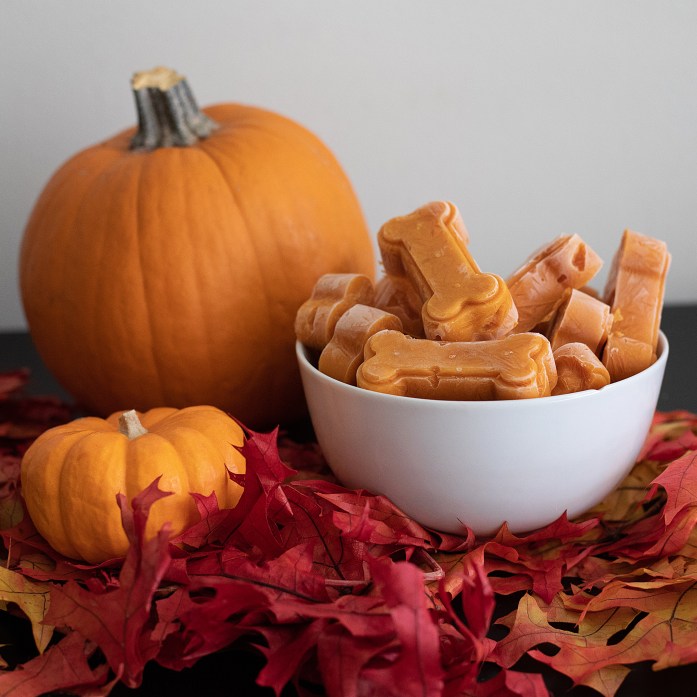
3. Pumpkin Froyo

Blend nonfat plain yogurt with pumpkin puree and freeze. Plain yogurt contains probiotics, and pumpkin is great for digestion. We use a pumpkin to yogurt ratio of 2:1. We feed a scoop of pumpkin with every meal and buy it in bulk here.
homemade peanut butter pumpkin dog treats
limited ingredient pumpkin dog treats

4. Watermelon Refresher

Watermelon is a great low calorie and delicious snack. Scoop out the inside of a small watermelon and add to food processor or blender. Add 1 can coconut milk, then blend.  If you do not have coconut milk, you can use plain nonfat yogurt, water or a small amount of coconut oil if desired. Fill tray, then freeze.
watermelon is safe for dogs

5. Berry Good Treats

Blend 1 cup frozen berries, 1/2 cup melted coconut oil, 1/2 cup of nonfat plain yogurt in a blender or food processor.  We use blueberries, strawberries, blackberries, or raspberries depending on what we have available. If the consistency is too thick, add water in small increments to adjust consistency. Fill trays and freeze.

6. Broccoli Greens Dog Breath Mints

Turns out that some greens are great for our pups AND can help their breath. Throw a few broccoli florets, a handful of fresh parsley, and a stalk of fresh mint leaves into the food processor with 1/2 cup of melted coconut oil (or 1 full can of coconut milk). The coconut oil helps the coat and the greens will help their breath. Add an extra 1/2 cup plain yogurt for a creamier consistency.  Fill trays, freeze and enjoy.  Your dog may not like eating their veggies, but once you add some yogurt or coconut oil, they’ll be begging for more.
dog breath mints - eliminate bad dog breath

7. Spinach Carrot Veggie Boost

Your dog can finally enjoy green smoothies with you (yum!). Spinach is a super food for humans AND dogs…the trick is getting fido to accept the greens. Pour a handful of spinach spinach, carrots, and bone broth into a food processor blender. Fill trays and freeze.

8. Frozen Baby Food Dog Treats

Baby food treats are the easiest to make…all you have to do is scoop and freeze! Limited ingredient baby food is great for dogs – babies have sensitive stomachs and eat simple foods which makes for great dog treats. Pick up some Gerber’s baby food from your local supermarket or order it online here. Any baby food will do, just make sure that it does not have added onions or garlic. Fill your silicone trays and freeze, that’s it! We love all dog friendly flavors; chicken, beef, apple, banana, sweet potato, ect

9. Homemade Pumpkin Banana Bread Dog Treat Blend

Scoop some pumpkin puree and a few bananas into a blender. For an added crunch, you can add 1/4 cup of rolled oats. Blend until smooth and add increments of 1/4 cup water if consistency is too thick.  Fill trays and freeze.

10. Frozen Broth with a Crunch

We mix Calvin’s kibble with dog friendly broth and then freeze it in a silicon tray for bite sized treats.  We fill half of the tray with kibble and then top it off with broth to help the kibble stick together. Dog friendly broth can be found online by brands such as Honest Kitchen. We’ve been loving the Honest Kitchen pour overs lately. If your pup has any food allergies, Honest Kitchen has broth available in all different types and flavors. If you are buying broth in the supermarket, make sure that there are no added ingredients like onion or garlic – This can be hard to find.
Happy Pupsicles!
-Your Pal Cal
 

Come, Sit, Stay: Train Your Dog to “Stay”

dog doing the stay command while wearing a blue plaid dog bandana

Teach a Dog to Stay: Training Your Dog to Stay

Training your dog to stay reliably is a great way to enhance their training. You can start teaching a puppy to “stay” as soon as it comes home. Once your dog masters the “stay” command, it will be able to stay through distractions and for as long as you want. The “stay” command isn’t too glamorous but is one of our most frequently used commands. Today, we’re going to look into the “Stay” command and how we proofed it to teach our dogs to stay with distractions.  This post assumes that the dog already knows a basic sit, stay, come. We found that the hardest part about teaching stay is using it in the real world and extending it to long periods of time. We can practice “stay” at home but out in the real world it is important to proof the command around distractions and not have to be concerned that the dog may get up once we’ve told them to stay.

When To Use Stay

Stay is a versatile command – when mastered, it is useful everywhere and the dog knows not to move until released. Stay can be taught to mean different things, so we will only be sharing how we use it. We use stay to indicate to Calvin that we don’t want him to move until he has an “ok.”  Stay is generally taught with the handler walking away from the dog – but in reality, we only use that example when we fly at the airport. Our most common use for stay is for Calvin to plant himself wherever we ask, even if we are remaining next to him.
Here are some of the ways that we use “stay”: At pet friendly stores, Calvin will “stay” at my feet as I sift through racks of clothing without sniffing around or exploring. At the office, Calvin will “stay” under the desk until released.  At home or restaurants, Calvin will “stay” on his bed during human meals. At crosswalks, Calvin will “stay” in place until it’s time to move. Of course, we can’t forget that Calvin holds a “stay” for every photo we take. We weren’t as concerned with Calvin doing a “Down Stay” vs. a “Sit Stay” – we don’t really care if he’s sitting or lying down as long as he isn’t moving. The actual position is up to him, and we are ok with that. Everyone’s needs are different, so for some people this distinction is important.
photo of san francisco from the top of bernal heights off leash dog park
dog running with human down the hill

Teaching your dog to stay for a long time

Once you can walk away from your pup while they are holding a stay, it’s time to take the command to the next level.  The next level means your pup will only need to be told one time and you will be able to go about your activities (including leaving the room) without them moving.

What you need

  1. Understanding of the basic stay command with a release word
  2. A Mat or towel
  3. High value treats
  4. A leash

Get Started & Practice

You will start small but eventually build up endurance so that your pup can hold an indefinite stay.
Find a way to fit practice into your daily activities and use a mat or towel to indicate where your pup needs to stay. Some good times to practice are when you are getting ready in the morning, preparing food, or during human meals. Weave the practice into your daily life – If you have a consistent practice schedule, your pup will soon master the command.

Corrections

When your dog breaks a stay, bring them back to their mat and repeat the command “stay.” Do not reward them if they have broken the stay. If you find that you need too many corrections, go back to holding the stay for a short period of time (1 minute). Another option is to use a leash to restrict the dog to a certain area so they cannot break the stay.
dog using the command stay in front of a city landscape

Build up training your dog to stay for a longer

You won’t be able to go from a basic stay to 30 minutes overnight. Practice in increments until the command is mastered. Start with holding a stay for 1 minute….then 5……10…..15 ect.

Master the “Stay” Command

Check off all these scenarios to proof your prolonged stay:
  1. Hold a stay in a pet friendly store around distractions, loud noises, and passersby
  2. Hold a stay for 45 minutes at home while the humans go about with their daily life
  3. Hold a stay at a restaurant (pet friendly patio)
  4. Hold a stay during human meals at home
  5. Hold a stay outside a coffee shop (make sure you can always keep an eye on your pet)
  6. Hold a stay for 1 minute, 5 minutes, 10 minutes, 30 minutes, 1 hour
  7. Throw a toy or food around your dog while they are holding their stay
  8. Hold a stay on the street while other dogs walk by

Enjoy your stay
-Your Pal Cal

training a dog to stay with a city landscape behind him

FAQ: Gentle Leader Dog Training

the gentler leader and dog leash connected under the chin

Training Your Dog to Use the Gentle Leader Head Collar

The gentle leader head collar (GL) can be best described as a training collar used to reinforce proper leash walking and distraction training. The dog is able to fully open their mouth and therefore the gentle leader does not stop biting or barking. Even though it can be used for dogs with mild behavioral issues that is not its main purpose and will not help for major behavior issues. The gentle leader can be purchased on Amazon or any Pet Store (our dogs wear a size Medium). We have tried the gentle leader vs. the easy walk harness and decided we prefer the gentle leader for our dogs. Here are the most frequently asked questions about the Gentle Leader for dogs…

Does the gentle leader work for barking? Does he bite?
Nope! and Nope! The GL will not control an aggressive dog or a dog with major behavior issues.

How do you put a gentle leader on a dog?
The GL strap attach behind the ears. The loop goes over the snout. The leash attaches at the loop under the snout. Pulling on the leash tightens the snout strap and deters unwanted behavior.

Is the gentle leader a good tool for my dog? 
Dogs will respond differently to training tools so there’s no right answer to this question. The GL worked for us but we know that some people prefer other tools for training.

Why did you choose the gentle leader?
A few Reasons….but we would first like to preface that not all training methods work for every dog and that we respect different training choices.

Skin Irritation: the skin under Calvin’s armpits is the most sensitive part of his body. He has very little hair there and it is constantly getting infected even without his harness on. We have tried countless harnesses….hundreds of dollars later, only the GL keeps his skin from getting irritated.
Best Results: for US the GL had the best results out of all training tools we have tried. We were introduced to it by a professional trainer and have found that in San Francisco it is often the tool of choice because it does not hurt the dog but can be extremely effective. Within 4 weeks Calvin was able to pass the CGC test WITHOUT the GL.
Reinforce Boundaries: The GL allows us as handlers to reinforce boundaries. It is a reminder that he needs to look to us for guidance and cannot focus on the distractions around him.
Pressure off the Neck: We wanted to minimize any pressure on the neck and potential trachea issues. When a lab gets stubborn…they don’t care how much pressure is applied.

Which gentle leader do you use?
We use the PetSafe quick release in size Medium and the Comfort Trainer in size 3 . You can also search for a “Halti” or “Head Collar” these use loops instead of a plastic clips and are more heavy duty.

What are the top use cases for the gentle leader?
When used correctly, the gentle leader is great for teaching proper leash etiquette and perfecting the leave it command. As a result, the dog is more focused while waiting for its handlers next directions.

How do you train with the gentle leader?
Like all training tools, the gentle leader does not automatically fix behavior. Rather, it is a tool that should be used to enforce proper behavior. The gentle leader is used with a leash correction – when the dog walks ahead or is fixated on a distraction, quickly pop the leash towards you with your correction word. The leash pop in your direction refocuses the dog’s attention towards you (the handler). This reinforces that the dog does not have the autonomy to pull at the leash or stay focused on a distraction – rather they should always be checking in with their handler. Focusing on thei handler is now a non-negotiable behavior!
Our walking etiquette command is “heel” + leash pop as soon as Calvin takes more than 2 steps ahead of us. Our distraction command is “leave it” + leash pop. Give the dog a chance to correct themselves before popping the leash. With time you will find that you no longer need the correction, just the command. Without using a correction and word, the dog will be confused as to why they are being corrected.

How long do you need to use it for good results?
We saw significant results after one month, and then continue to see better behavior everytime we use it. Now, we use the GL for 50% of outings, at the airport, and the office. During evaluations, like the Canine Good Citizen Test, dogs are not allowed to use any training tools.  After one month, Calvin was able to pass without using the GL.

How do you get your dog comfortable with the gentle  leader? Does he like it?
The answer is no….your dog won’t like the GL. He may become indifferent to it but if asked to choose, no dog would choose the GL! The truth is, dogs don’t like giving up control and that is precisely what the GL does. It took a few weeks for Calvin to stop pawing at his face but he eventually did. Sometimes, he will still rub his snout on things. People who use the GL will agree that it’s not always about what the dog wants, but what is best for structure, training and good behavior. A dog that is allowed to do whatever it wants and pull at the leash is still a great dog but it’s a dog who runs its household.

How do you size the gentle leader?
Like a harness, the GL is fully adjustable. Our dogs wear a Gentle Leader size Medium. Ideally, you should be able to fit two fingers behind the head strap and the snout loop should be lose enough to slide to the tip of the nose without being able to fully slide off.

Can he still open his mouth?
If your GL is sized correctly, the dog should be able to entirely open their mouth, hold balls, and pant.

Do you get weird looks outside?
Everyday…but the GL has been getting more popular. We like to joke that you can tell how dog friendly a town is by how many people are familiar with the gentle leader. Lucky for you, it’s no one’s business what training tool you use or how much you choose to train your dog. As our social media account has grown, we get a lot of comments about how we should do things. Dog raising, kid raising, and life in general is no one’s business so just do whatever works best for you. We choose the GL and dog training is important to our lifestyle but entirely understand that some people do not prioritize the same things. You do you!

Do people stop you less on the street?
Yep! Calvin socializes with humans and other dogs all day long. He meets up with friends at the park and beach – on the street, we actually prefer being able to go about with our life without constant stoping. We do not let Calvin have on leash greetings, and he has learned to ignore when strangers call out to him if we tell him to leave it. All of these learned behaviors are thanks to the GL! The added benefit is that that GL does make people less likely to approach your dog, so it becomes easier to teach the dog how to ignore crowds and other dogs!

How do you explain the gentle leader to strangers?
We tell strangers that GL is a training tool best used for leash etiquette and pulling. It does not have to do with barking or biting and he is as friendly as they come.

How do you educate people when they ask “Does he bite”?
“Nope, never….but he could if he wanted!” Is our go to joke and then we will show them how Calvin’s mouth can open all the way with the GL on. If the stranger is being particularly rude, we do not entertain them with our time and just say “no” and walk away. Don’t put up with rudeness about how you choose to train your dog!
the gentle leader is great for dog training. the gentle leader is different from the easy walk harness.
Good Luck with the GL
-Your Pal Cal